
Forages for Improving Saline Soils
What is Salinity?
- Saline soils: High concentrations of soluble salts (e.g., sodium sulfate, magnesium sulfate, calcium sulfate, sodium chloride) with normal pH.
- Alkaline soils: Low soluble salts but pH > 8.5 due to sodium ions on clay particles.
- Manitoba has ~0.6 million acres affected by salinity; true alkaline soils are rare.
How Saline Soils Form
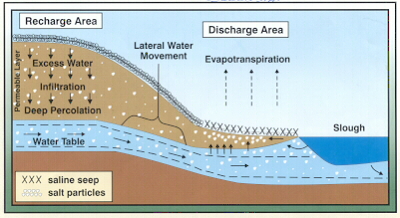
- Excess water in recharge areas moves into groundwater, dissolving salts.
- Groundwater flows laterally and rises near the surface in discharge areas.
- When water table is <1.5 m from surface, salts wick upward and remain after evaporation, forming white/gray deposits.
Figure 1:Ground Water Flow and Soil Salinity
Managing Salinity with Forages
Salinity cannot be eliminated, but water management and forage planting can reduce salt accumulation.
Effective Practices:
- Plant deep-rooted perennial forages (e.g., alfalfa) in recharge areas to use excess soil moisture.
- Establish 20–60 m forage bands before discharge areas to intercept water.
- Plant salt-tolerant forages in saline zones to prevent salts from reaching the surface.
Figure 2:Forage Placement for Reducing Saline Problems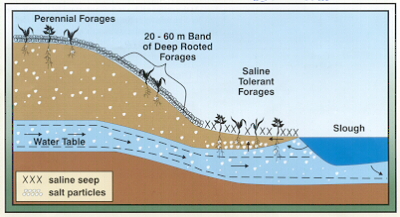
Forage Establishment
- Seed saline areas when barley (most salt-tolerant crop) can still grow.
- Seeding windows: Early spring, early summer, late August, early September.
- Legumes: Spring or early summer only for winter survival.
- Double seeding rate compared to non-saline soils.
- Combine multiple salt-tolerant species for variable salinity.
Salt Tolerance of Forages (Table 1 Highlights)
- Very High: Tall wheatgrass, beardless wild rye, slender wheatgrass.
- High: Altai wild rye, Russian wild rye, western wheatgrass, tall fescue.
- Moderate: Alfalfa, sweetclover, birdsfoot trefoil, bromegrass.
- Low: Timothy, alsike clover, red clover, reed canary grass, sainfoin.
Table 1: Relative Tolerance of Crops and Weeds to Salt
Salt Tolerance Level |
Forages |
Speed of Forage Establishment |
Weed/Crop |
Very High |
Tall Wheatgrass |
Slow |
Red Samphire |
Very High |
Beardless Wild-rye |
Medium |
Sea Blight |
Very High |
Slender Wheatgrass |
Fast |
— |
High |
Altai Wild-rye |
Slow |
Kochia |
High |
Russian Wild-Rye |
Slow |
Foxtail Barley |
High |
Western Wheatgrass |
Slow |
— |
High |
Tall Fescue |
Fast |
— |
Moderate |
Alfalfa |
Fast |
Barley |
Moderate |
Sweetclover |
Medium |
Wheat |
Moderate |
Birdsfoot Trefoil |
Slow |
Fall Rye |
Moderate |
Bromegrass |
Slow |
Oats |
Low Tolerance |
Timothy |
— |
Flax |
Low Tolerance |
Alsike Clover |
— |
Canola |
Low Tolerance |
Red Clover |
— |
Corn |
Low Tolerance |
Reed Canary Grass |
— |
Beans |
Low Tolerance |
Sainfoin |
— |
Peas |
Soil Fertility
- Saline soils often lack nitrogen and phosphorus.
- Soil testing recommended; proper fertility improves yield and weed competition.
Important Notes
- Tall wheatgrass: Highest salt tolerance but coarse and unpalatable for grazing.
- Alfalfa: Moderately salt-tolerant; excellent for recharge areas due to deep roots and high water use.
- Extreme salinity (white salt crust) makes establishment very difficult—focus on bands around saline spots and recharge areas.