
Archives of Manitoba
Managing Records in the Manitoba Government
enlarge image
The Manitoba government has a responsibility to create and manage the records that document government activities, decisions, and interactions. This responsibility is sometimes referred to as a ‘duty to document’.
Responsibilities for managing records and information are embodied in The Archives and Recordkeeping Act, further described in the Recordkeeping Framework for Departments and Agencies: Policies and Requirements, and detailed in an ever-growing body of guidance released by the Archives of Manitoba on this website.
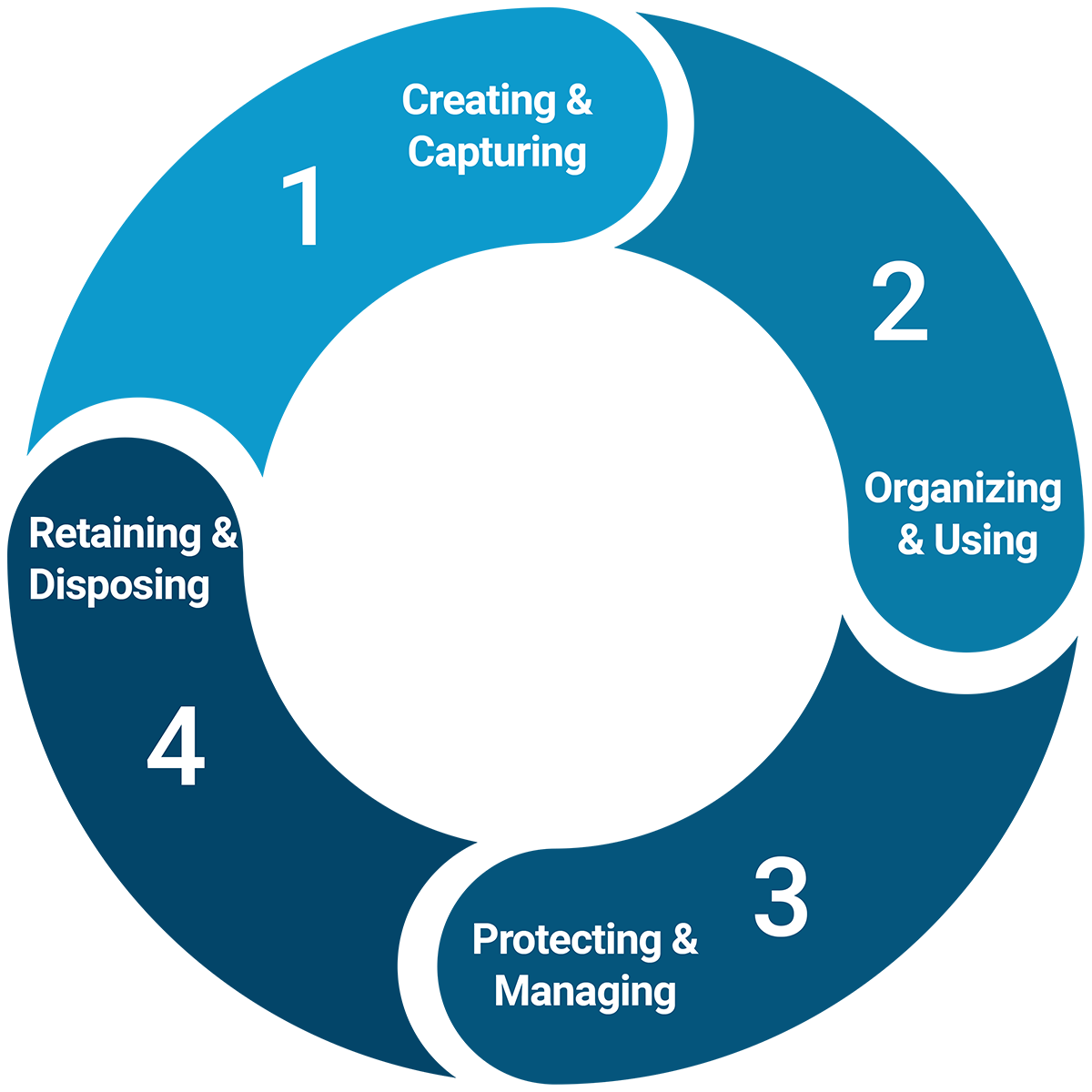
The following provides a high-level overview of the recordkeeping responsibilities in each interdependent phase of the recordkeeping life cycle.
- 1 - Creating and Capturing Records
- 2 - Organizing and Using Records
- 3 - Protecting and Managing Records
- 4 - Retaining and Disposing of Records
1 - Creating and Capturing Records
Public servants have a responsibility to ensure that the actions and decisions of government are documented. Government records are defined as recorded information in any form, created or received in the conduct of government business, and kept as evidence of activities and decisions.
Creating records: When records are created or received, they must provide adequate information to document the activity, action, or decision. The goal is to create trustworthy, accessible, and reliable records that will be there when needed and for as long as required.
Properly created, captured, and organized records help government to:
- support decision-making
- outline responsibilities
- document rights and entitlements
- support transparency and accountability
- establish the foundation for sustainable and effective programs, products, and services
- drive collaboration and communication
- preserve vital information for discovery and reuse
- protect the corporate memory of an organization
Records that will provide reliable evidence of activities and transactions have the following qualities:
Authenticity - a record can be proven to be what it claims to be.
An authentic record clearly documents the creator, the date the record was created and modified, and the purpose of the record.
Date stamps, original signatures, identity management, and authentication metadata can help to ensure a record is authentic.
Integrity - a record is complete and unaltered.
All of the information/data related to a record is present. For example, case files should have all of the related records filed together. If records are missing or cannot be located, the file has lost its integrity.
The integrity of a record is influenced by the system and processes that support recordkeeping. For example, electronic systems that do not track if records are altered, moved, or deleted do not demonstrate integrity.
Usability - a record can be located, retrieved, and used in the course of business.
Records must remain legible and accessible for as long as they are needed. For example, records stored in obsolete file formats are not useable.
Capturing records means keeping or storing records in a recordkeeping system.
The goals of a recordkeeping system are to:
- make it easy for users to file, locate, and retrieve the records they need
- group related records together so that a ‘complete’ record of the business activity or case is available
- remove the need for individual or ad hoc decisions on managing records to help prevent duplication and unmanaged accumulation
- reflect the business activity
- make it possible to apply records management rules accountably and comprehensively
Capturing records in a reliable recordkeeping system according to established procedures will help to ensure that the records retain their authenticity, integrity, and usability.
Over time the combination of good creation and capture practices along with adequate recordkeeping systems will result in reliable records that can stand up to scrutiny and be relied upon to make evidence-based decisions.
For more information on creating and capturing records, see the following guidance:
- Identifying Government Records (PDF)
- Creating and Capturing Records (PDF)
- Recordkeeping Systems (PDF)
- Text & Instant Messages (PDF)
- Microsoft 365: Teams – Recordkeeping Guidance (PDF)
- Working Remotely and Recordkeeping Responsibilities (PDF)
- Transitory Records (PDF)
- Records Management Checklists for New and Exiting Employees (PDF)
2 - Organizing and Using Records
Organizing records is an essential records and information management practice. Records should be organized in a shared system so that they can be easily accessed by authorized users.
Good organizing includes agreed upon practices and procedures to ensure related records are being saved and managed together.
Classification is a core component of organizing records and information and may be achieved in a variety of ways (e.g. hierarchical file structures, robust indexing/metadata tagging).
A good organizational system with proper classification will allow records to be managed comprehensively.
Using records effectively is dependent on the qualities identified above that make for good records. Usable records are those that can be located, re-purposed, and shared (when authorized), thereby leveraging their value to government.
Ensuring ongoing use of records may also require conversion or migration. For example, the digitization of paper-based files is a common conversion practice that improves accessibility and use of the records.
Organizing and using records goes hand-in-hand with the life cycle of the records:
- Active files are those that are being actively created, added to, and used to perform an activity, make decisions, or complete a transaction. They are referred to regularly and should be close at hand and quickly accessible.
- Closed files are those that are no longer being added to because the activity, decision, or transaction is complete.
- Semi-active files are those that are closed, but are needed to refer back to the records to satisfy other requirements. For example, the active use of client files may end when the files are closed, payment satisfied, or services completed. After this time, the records may still need to be accessed for a certain amount of time (e.g. an appeal period or program review time frame).
For more information on organizing and using records see:
- File Structures (PDF)
- Digitizing Records (PDF)
- Digitizing Records, Appendix A – Business Needs Analysis (PDF)
- Determining Retention Periods (PDF)
3 - Protecting and Managing Records
Protecting and managing records includes a wide variety of activities to ensure that records and information will retain their authenticity and integrity, will be reliable and usable, and will be maintained for as long as required.
These activities can include:
- ensuring digital systems have appropriate capabilities to manage the records throughout their life cycle
- assessing and mitigating risks to the records
- building adequate business rules, policies, processes, and procedures
- preparing records schedules so the retention and disposition rules are established and remain up-to-date
- establishing classification schema and adequate indexing so the records can be managed
- improving the metadata associated with the records, both within the systems used and as control data to manage the records
- upholding security processes and access requirements
- developing audit trails to ensure all actions on the records are authorized
Managing records effectively increases security and intellectual control over government’s most important assets and decreases unnecessary costs and risks.
An important aspect of protecting and managing records is embodying recordkeeping requirements in records schedules.
Records schedules are a basic mechanism for managing government records. They:
- identify the functions and activities of a program area and the records that provide evidence of those activities
- specify how long records need to be kept to meet legal, fiscal and administrative needs
- allow for authorized disposal when the records are no longer required by the records creator
- apply to records in all media including paper and digital records
Under the The Archives and Recordkeeping Act:
- schedules must be prepared for all government records, including electronic records
- each department/agency must prepare records schedules for approval by the Archivist of Manitoba following the policies and procedures established
- records must not be destroyed without the authority of an approved records schedule
For more information on protecting and managing records, see:
- Managing Records to Mitigate Risk (PDF)
- High Risk/High Value Records and Information (PDF)
- Recordkeeping Systems (PDF)
- Recordkeeping Standards (PDF)
- Functional Analysis for Recordkeeping (PDF)
- Records Schedules: What Managers Need to Know (PDF)
- Records Scheduling: The Recommended Approach (PDF)
- GRO Procedure 1: Preparing Records Schedules (PDF)
- Determining Retention Periods (PDF)
- Records Management Checklists for New and Exiting Employees (PDF)
- Compass: Capacity Assessment Tool for Recordkeeping (PDF)
4 - Retaining and Disposing of Records
Retaining records: How long records must be kept has a lot to do with why the records are needed in the first place. Records provide evidence of 'who, what, when and why' something happened. When determining how long to retain records, program areas need to consider accountability for actions and decisions, evidence to protect against liability, reference for future actions, and support for planning and evaluation.
Retention periods are usually applied to groups of related records (records series), since records are often interdependent. The scheduling process assists managers in identifying records series and determining appropriate retention periods through analysis and consideration of the business context and requirements noted above.
Once established, the retention periods are documented in records schedules, which serve as ongoing authorities guiding the retention and disposition of the records over time.
Digital records are retained by the department for the full retention period. Digital records that have a long retention period may need to be converted or migrated to ensure they remain trustworthy, reliable, and accessible for as long as required.
Physical records can be retained by the department for the full retention period, or they can be moved to semi-active storage at the Government Records Centre (GRC) once the files are closed and are no longer frequently accessed.
The GRC is a purpose-built, cost-effective, and secure storage facility that provides centralized records storage, retrieval, and destruction services for all government departments and agencies. Transferring records to the GRC is a regulated process to ensure that records are managed in accordance with records management best practices. Records in semi-active storage can be retrieved from the GRC by the office responsible for the records. GRC provides secure delivery and pick-up, and tracks retrieved files.
For more information about retaining records see:
- Determining Retention Periods (PDF)
- “Transferring Records” training video
- Procedure GRO 2: Transferring Government Records (PDF) (to the GRC)
- Procedure GRO 3: Retrieving Records (PDF) (from the GRC)
Disposing of government records can only take place when records have reached the end of their scheduled retention period and they must be disposed of in an authorized manner. Government records have two possible disposal actions: ‘destruction’ and ’transfer to archives’ (permanent preservation).
Destruction: Regardless of format, in order for records to be destroyed in an authorized way, records must:
- be covered by an approved records schedule
- be due for disposal
- not be subject to a FIPPA request, litigation hold, audit, or other investigation
- be securely destroyed or deleted, according to industry standards that ensure the records cannot be reconstituted or restored
- have their destruction documented in a way that demonstrates accountability for the action
For digital records, some areas in government will have more robust recordkeeping systems and controlled practices that allow for destruction in a seamless, automated, and authorized way. Regardless of the technological capabilities available, program areas need to ensure that deletion of digital government records meets the above minimum requirements. This may require additional practices and procedures to support the process.
For physical records, the Government Records Centre provides a controlled, cost-effective, documented, secure, and accountable destruction service. Records are shredded according to industry standards and the shredded paper is recycled.
Use of alternative methods for destruction of government records is permitted in some circumstances. See Procedure GRO 2 Transferring Government Records (PDF) and Government Records Policy: Office Paper Shredders (PDF).
Transfer to Archives: A small percentage of records created by government are deemed to have enduring value to government and society. This is determined by the Archives of Manitoba during the records scheduling process.
Physical archival records are transferred to the environmentally-controlled vaults of the Archives of Manitoba for preservation. The Archives provides a secure and protective environment, and also facilitates the long-term use of the records by government and the public.
The Archives does not currently have the capability to acquire, protect, and preserve digital records. Departments must protect digital records until the Archives can accept digital records transfers.
Access to archival records, as with all other government records, is subject to legislation and policy governing access to information and protection of privacy.
For more information about archival records, see:
For more information about Records and Information Management in the Manitoba Government, see: