
Archives of Manitoba
Keystone Archives Descriptive Database Help: Understanding Search Results
7. How Archival Records Are Organized
Understanding a little about how archival records are organized can help you to use Keystone more effectively.
Archives are not organized by their subject, but on the basis of who created them. Records created by a particular office, organization or person are kept together and not intermingled with records from other creators or divided into subject areas. The term ‘entity’ is used throughout the database as a generic term for records creating bodies at any level of the Government of Manitoba, its agencies and local public bodies or the Hudson’s Bay Company (HBC), including all levels of its hierarchy, from posts and outposts to administrative bodies in North America and in London.
The Archives of Manitoba holdings include records created by:
- the Manitoba government
- the Hudson’s Bay Company
- individuals, families, organizations, businesses and community groups in Manitoba, as well as personal records related to (but not created by) the Hudson’s Bay Company
The Archives’ collection is a rich resource for the study of the history of Manitoba and its people, as well as the history of the Hudson's Bay Company (HBC). Please see About our holdings for more information about the nature and scope of the collection.
Government of Manitoba and Hudson’s Bay Company records are represented in the database somewhat differently from private (non-governmental, non-HBC) records:
- How Government of Manitoba and Hudson’s Bay Company records are organized
- How private records are organized
How Government of Manitoba and Hudson’s Bay Company Records are Organized
The Keystone database consists of three types of descriptions that can help you to find and understand records created by the Government of Manitoba or Hudson’s Bay Company (HBC):
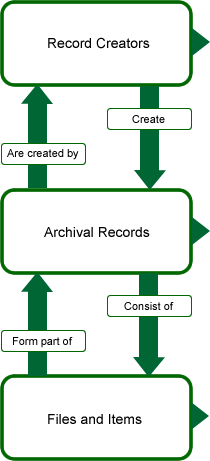 |
Descriptions of records creators (government or HBC entities) that have been responsible for creating or accumulating records. |
| Descriptions of archival records that have been created by government or HBC entities. These groups of records are called series, and may be divided into sub-groups called sub-series | |
| Descriptions of the listings (files and items) that make up the different groups of records (series and sub-series) created by Manitoba government or HBC entities |
Government and HBC entities create records in the course of their work
Government and HBC entities are created to undertake the work of the government or the company. In the course of fulfilling their mandate or delivering a service, an entity creates records to document its activities and support its work. Some of these records become archives.
Records are organized in groups
Records created by Government of Manitoba or HBC entities are organized into groups called series. A series is a group of records that:
- result from a particular function or activity
- share a particular format
- were kept together as a unit by a government or HBC entity for some other reason
Series of records were created by government or HBC entities during the course of their regular business and they are maintained in the Archives largely as they were when they were created by these offices. In this way, the records retain their value as evidence of what a particular entity did.
Examples of Government of Manitoba series include:
- Provincial Court judges’ notebooks
- Minister of Northern Affairs office files
- Tourism marketing and promotional films
Examples of HBC series include:
- Governor and Committee minute books and related records
- Montreal Department abstracts of servants' accounts
- Albany correspondence books
In some cases, series have been further divided into component parts called sub-series.
Groups of records consist of files or items
Series or sub-series consist of files or items. Files or items may include:
- paper files
- volumes such as a minute book or accounting ledgers
- architectural drawings
- maps and other cartographic records
- photographs
- sound, film or video recordings
- documentary art pieces
- artifacts
It is these files and items, represented as “Listings” in the Keystone database, that are the material that may be ordered and viewed in the Archives’ Research Room or consulted on microfilm.
In the Keystone database, each file or item description is linked to the description of the series to which it belongs. Each series is then linked to the descriptions of the record creators, the entities that were responsible for creating it. These linkages help you to understand why a particular file or item may have been created in the course of a particular activity or business.
How Private Records are Organized
In addition to records created by the government of Manitoba and Hudson’s Bay Company, the Archives’ collection includes historical records created by individuals, families, organizations, businesses and community groups in Manitoba, as well as personal records related to (but not created by) the Hudson’s Bay Company. These records are organized in a similar but slightly different manner than Government of Manitoba and Hudson’s Bay Company records.
Archives are not organized by their subject content. Rather, they are arranged into groups according to the person or organization that created or accumulated them in the course of conducting their personal, professional or business activities.
These groups are known as fonds or collections:
A fonds is all of the records that have been created or accumulated -- in the course of their personal or organizational activity --- by a particular person, family or group that are held by the Archives.
A collection is a group of material brought together consciously by the Archives or a collector based on a particular topic or type of material.
Examples include:
- Beatrice Brigden fonds
- Manitoba Chinese Historical Society fonds
- Manitoba Dairy Farms Limited collection
- Peter Fidler fonds
When individual items are acquired, they are usually described as items (not as fonds or collections). Examples include:
- "Journal of travels of Jas Bissett from Lachine to the Red River Settlement, Rupert's Land"
- John Edward Harriott memoir
The Organization of Fonds and Collections
Fonds and collections may be organized into component parts called series. A series is a group of records that:
- result from a particular function or activity
- share a particular format
- were kept together as a unit by a person or organization for some other reason
Series can be further sub-divided into groups called sub-series.
Series or sub-series consist of files or items (listings). Files or items may include:
- paper files
- volumes such as a minute book or accounting ledgers
- architectural drawings
- maps and other cartographic records
- photographs
- sound, film or video recordings
- documentary art pieces
- artifacts
It is these files and items that are the material that may be ordered and viewed in the Archives’ Research Room or consulted on microfilm.