Physical Activity
Benefits of Physical Activity
- Children who are more physically active show better academic performance.
- Regular physical education classes in school will keep kids active through their teens and help them control their weight.
- Children who are more physically active have a better self-esteem and body image.
- Regular physical activity improves children’s mental health and contributes to growth and development.
- Regular physical activity reduces the likelihood of obesity. Both obesity and inactivity increase the risk of cardiovascular disease.
- Daily physical activity improves children’s skeletal health. This, in turn, reduces their risk of developing osteoporosis in the future.
- Regular physical activity in children can become a habit that carries over into adulthood.
- Regular physical activity leads to better behaviour and a healthy lifestyle.
- An increase in youth participation in physical activity will cut health care costs by decreasing future risk related diseases.
Physical Activity within a Comprehensive School Health Model
To find more about how schools can use a comprehensive school health approach to increase physical activity levels, see the Joint Consortium for School Health’s Physical Activity within a Comprehensive School Health Model (2009) toolkit. It is a series of resources that identifies the most effective strategies for addressing physical activity in schools based on evidence drawn from Canadian educators and researchers.
- JCSH Physical Activity Toolkit: School Policy Makers

- JCSH Physical Activity Toolkit: Researchers
- JCSH Physical Activity Toolkit: Decision Makers
- JCSH Physical Activity Toolkit: Best Practices
- JCSH Physical Activity Fact Sheet: The School Community's Role
- JCSH Physical Activity Fact Sheet: The Benefits
- JCSH Physical Activity Fact: Sheet: Schools as a Setting
- JCSH Physical Activity Fact Sheet: Specific Populations
Physical Literacy
Individuals who are physically literate move with competence and confidence in a wide variety of physical activities in multiple environments that benefit the healthy development of the whole person. Physically literate individuals consistently develop the motivation and ability to understand, communicate, apply, and analyze different forms of movement. They are able to demonstrate a variety of movements confidently, competently, creatively and strategically across a wide range of health-related physical activities. These skills enable individuals to make healthy, active choices that are both beneficial to and respectful of their whole self, others, and their environment.
Research has shown that being physically active later in life depends on an individual's ability to feel confident in an activity setting. That confidence most often comes from having learned fundamental movement and sport skills, or physical literacy, as a child. Research has also shown that without the development of physical literacy, many children and youth withdraw from physical activity and sport and turn to more inactive and/or unhealthy choices during their leisure time (CS4Life).
Physical Literacy Toolkit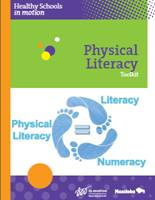
This toolkit is designed to enhance the movement repertoire of children and youth by increasing the number of skills they are competent in, as well as increasing their overall proficiency level in a fun setting. This kit will provide “multi-station circuit training” examples that can be easily implemented in the gymnasium setting. Repetition based learning in a fun setting is the basis of the circuit design.
Examples for grades 1-3, 4-6, 7-9, 10-12 are provided and aligned to curricular objectives, and consistent with long term participant development principles.
Recess Toolkit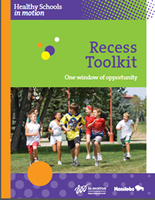
Recess provides an opportunity during which children can express their movement repertoire in unstructured free play or in semi-structured play facilitated by appropriate equipment and supervision. The Recess Toolkit provides a resource to aid schools in making recess a safe and active play time, during which the physical literacy of children can develop. This resource highlights best practice methods including games and equipment, indoor and outdoor recess, as well as considerations for administrators, parents, teachers and PE teachers.
PLAY Tools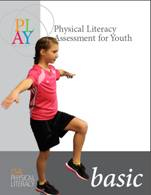
The Physical Literacy Assessment for Youth (PLAY) Tools are meant to improve our population’s level of physical literacy.
Directed at individuals aged seven and up, the PLAY Tools determine gaps in physical literacy development, and provide calls-to-action to help improve these areas.
Visit physicalliteracy.ca/play-tools/ for more information.
Physical Literacy Links
Healthy Schools is a partnership of:
Health | Education and Early Childhood Learning | Child and Youth Programs