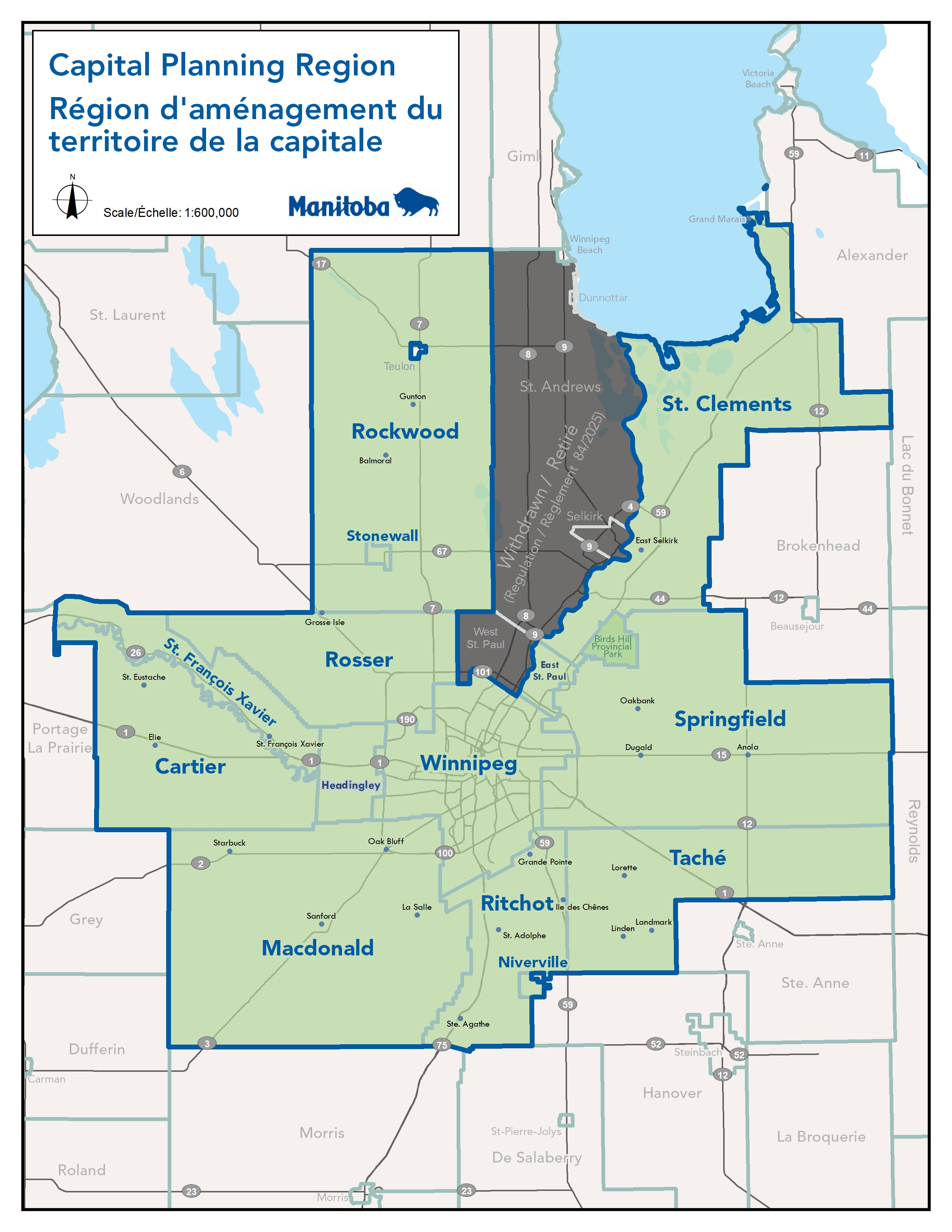
Manitoba’s Capital Planning Region: Winnipeg Metropolitan Region
Available in alternate formats, on request. Please call 204-945-2150 or email MRCPD@gov.mb.ca.
For information about Manitoba’s Capital Planning Region, please visit the Winnipeg Metropolitan Region Website.
Regional planning is adopted world-wide and in major Canadian cities. Regional planning can deliver coordinated and cost-effective service delivery, improved consistency of planning policy, and more effective single window regional approaches to attract development.
Regional approaches supplement but do not replace local municipal planning authority and have the following broad public benefits:
- Housing affordability – allows for conscious planning of diverse housing options within a reasonable driving distance from places of employment
- Ease of transportation – regional approaches support easier movement of people, and reduced travel times between homes and jobs, for example
- Shared approach to attracting business – economic growth and investment brings higher paying and better jobs for residents of the region as a whole
- Poverty alleviation – inconsistent planning and infrastructure decisions can lead to housing and public transit gaps that can inadvertently separate people from employment areas
- Indigenous relations – regional planning can strengthen collaboration on services, land agreements and foster respect for treaty land rights
Capital Planning Region (CPR)
The CPR currently operates as the Winnipeg Metropolitan Region. Member municipalities sit on the Board of Directors. The Minister of Municipal and Northern Relations may appoint up to two directors to the CPR Board, in accordance with Manitoba’s Agencies, Boards and Commissions appointment process.
The CPR is mandated to enhance economic and social development by improving and coordinating sustainable land use and development in the region by:
- adopting a regional plan
- facilitating and promoting regional considerations in providing infrastructure and services
- leading the development of regional responses to the planning issues of its regional member municipalities
- identifying and promoting opportunities for the regional member municipalities to cooperate in the cost-effective development of infrastructure and the provision of services on a regional basis
In early 2025, a new regional planning process began, grounded in municipal and regional needs and aligned with provincial requirements. Work is now underway to engage a broad range of perspectives to help shape the strategic direction of a new regional plan.
Recent Legislative and Regulatory Amendments
On June 3, 2025, Bill 4 - The Planning Amendment Act – received royal assent. This new legislation resets the relationship of Manitoba’s municipalities in the Capital Region by providing a choice to sit at the regional table. The best way to build communities across the province is to bring willing partners together to help them develop a coordinated and sustainable long-term vision for the region. For Bill 4 Frequently Asked Questions please click here.
The following municipalities have adopted formal resolutions to withdraw from membership on the board of the capital planning region: Selkirk, West St. Paul, Dunnottar, St. Andrews, Macdonald, Springfield, Taché, Rockwood, East St. Paul, St. Clements, and Stonewall. As of June 25, 2026, Selkirk, West St. Paul, Dunnottar, St. Andrews, Macdonald, Springfield, Taché, Rockwood, East St. Paul, St. Clements, and Stonewall have been formally withdrawn from membership under The Capital Planning Region – Regional Member Municipalities Regulation.
On February 17, 2026, amendments to the Capital Planning Region (CPR) Regulation were enacted. The regulation changes reaffirm our government’s commitment to regional planning by addressing local concerns related to board representation, decision‑making processes, and public hearing requirements. The amendments strengthen the Board’s autonomy and directly respond to feedback received from municipalities across the capital region. We remain committed to supporting the work of the capital planning region board and its stakeholders as we build consensus around a renewed vision for a regional plan.
To see the CPR Frequently Asked Questions in English, click here. To see the regulation in English, click here.
To see the CPR Frequently Asked Questions in French, click here. To see the regulation in French, click here. The Manitoba Government passed Bill 33 (The Planning Amendment and City of Winnipeg Charter Amendment Act) on June 1, 2026. This law is now in effect. Bill 33 makes changes to the scope of Municipal Board authority, Regional Planning, Housing and Supply Managed Industries.
To see the Bill 33 Guide and FAQs in English, click here. To see the Bill 33 Guide and FAQs in French, click here.