Mitigating The Risks Of Delayed Seeding
In years with excessive moisture farmers face the possibility of delayed seeding. Early seeding generally results in higher yields. As seeding is delayed, crops have less time to develop, may face greater heat stress, and are at higher risk of fall frost. These factors reduce yield potential and can also affect grain quality. If seeding is pushed back into late May or June farmers may need to consider changing cropping plans.
Data from Manitoba Agricultural Services Corporation (MASC) shows yield declines as seeding is delayed. The figure below shows the relative yield of various crops as seeding date moves from late April to mid-June over a 10-year period from 2015 to 2024. Average relative yields were highest for barley, flax, corn, oat, wheat, and sunflowers when seeded late April.
Seeding Date Effect on Crop Yields (2015-2024)
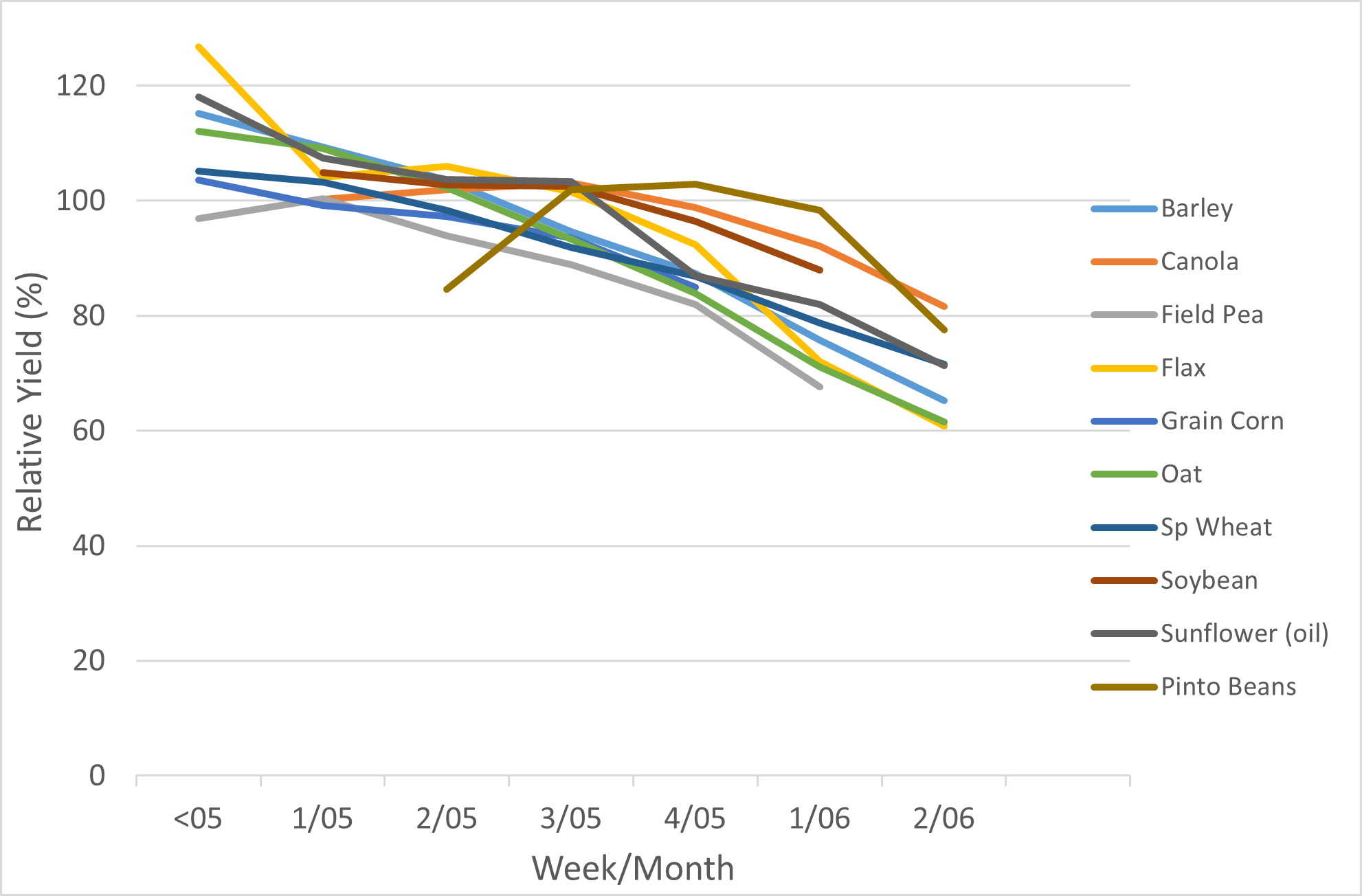
Data Source: Manitoba Agricultural Services Corporation
Cereal Crops
Yield potential in small grain crops is a function of number of heads per area, kernel number per head, and kernel weight. In grain corn, yield components include plants per acre, ears per plant, kernels per ear, and kernel weight. Late seeding can reduce one or more of these components, lowering yield potential.
A shortened growing season increases the risk of fall frost, which affects both yield and quality. Increased risk of high daytime temperatures can affect crop development at various points throughout the season. High temperatures during flowering can increase floret abortion.
Recommendations for delayed seeding:
Spring cereals
· Increase seeding rates to target the high end of the recommended plant population
· Consider selecting early maturing varieties to reduce the risk of fall frost damage
· Choose varieties with a good disease package and consider fungicide applications:
Grain corn
· Consider switching to a lower corn heat unit (CHU) hybrid or consider planting shorter season crops instead
Oilseed Crops
Oilseed crops are also sensitive to delayed seeding, especially when flowering occurs during hot, dry conditions. Target appropriate seeding rates to overcome issues with weedy fields, poor emergence conditions, or crop pests. Higher seeding rates can also be used to combat soil conditions if prone to crusting or there is heavy weed pressure at the time of seeding. As well, growers could target shallower seeding to facilitate rapid plant emergence with optimal moisture.
The general recommendations for seeding dates of oilseed crops for optimum yields are between May 1 to May 31 for flax, canola, mustard and oilseed sunflowers. Key factor for canola is soil temperature of 8-10 C to promote fast emergence and maturity through higher risk growth stages. Confectionary sunflowers should be sown by the third week of May. When seeding is delayed, farmers may want to consider selecting earlier maturing varieties within the crop type to reduce the potential of fall frost damage or excess weathering, especially for sunflowers.
Recommendations for delayed seeding:
Canola
· If seeding is delayed into mid-June, earlier maturing varieties should be selected, and sown at a heavier rate to increase plant uniformity and reduce branching, which in turn reduces days to maturity.
· Delayed seeding can mean the crop will flower during very hot days, which can result in heat blast and flower/pod abortion in the crop
· An early frost could mean immature seeds with frost damage, and high green seed counts. Yields will be reduced as frosted seeds will lose bushel weight and could be too light and blow out the back of the combine when harvested.
Flax
· Late seeding of a flax crop is not as much of a concern as other oilseeds.
· Delayed seeding can result in longer straw, and greater green stem issues at harvest, but can be managed via swathing or use of a crop desiccant. In an open fall, flax can stand and ripen without much shelling while other, more sensitive crops such as canola, are being harvested.
Sunflowers
· If seeding is delayed past the first week of June, the risk of a killing fall frost becomes much greater.
· An early frost could result in immature seeds with reduced bushel weights and the possibility an unmarketable product.
· When forced to plant late, a very early confection type sunflower or oil-type sunflowers are recommended.
Pulse & Soybeans
Recommendations for delayed seeding:
Field Peas
· Yields will usually be reduced if peas are seeded after the third week in May. Delayed seeding can increase the chance of higher temperatures during flowering in July, and a potential reduction in yield.
· Seeding into June is generally not recommended for field peas.
· Field Peas can be seeded early in the growing season. Very early maturing varieties are available for areas with a restricted growing season. These varieties generally mature one week before those rated as medium.
· Field peas should be sown into moisture. Seeding depth should be increased with soils with a low water-holding capacity. Seeding at a uniform depth should result in uniform emergence and maturity.
Soybeans
· Typical Seeding dates May 10 to 30, or when the average soil temperature has warmed up to at least 10° C, 18 - 22° C is ideal.
· Seedlings can tolerate a light spring frost (-2.8° C for a short period) but cannot recover if damaged.
· If you have chosen a longer season variety than what would normally be recommended for your region then switching to an earlier season variety when planting into June is best.
· MASC seeding deadlines have been adjusted to reflect the change in variety maturity.
· MASC data demonstrates that seeding into early June can still result in reasonable yield expectations.
Additional Resources:
· To calculate optimum seeding rates using plant population, please refer to the following link: https://onlinecalculatorsdev.azurewebsites.net/calculators/seeding-rate.
· For variety selection information including disease resistance and maturity ratings visit www.seedmb.ca